
In the world of physics, the term “work” is more than just a task you do during your 9-to-5. In the scientific realm, work in physics has a precise definition and plays a vital role in understanding how forces interact with objects. Whether you’re a student learning the basics of physics or someone curious about how everyday devices like vacuum cleaners or noise-canceling headphones work, grasping the concept of work is key.
This article will walk you through work in physics, explaining its definition, formula, units, and some fascinating examples. By the end, you’ll have a solid understanding of this fundamental physics concept and how to calculate work in various situations.
What is Work in Physics?
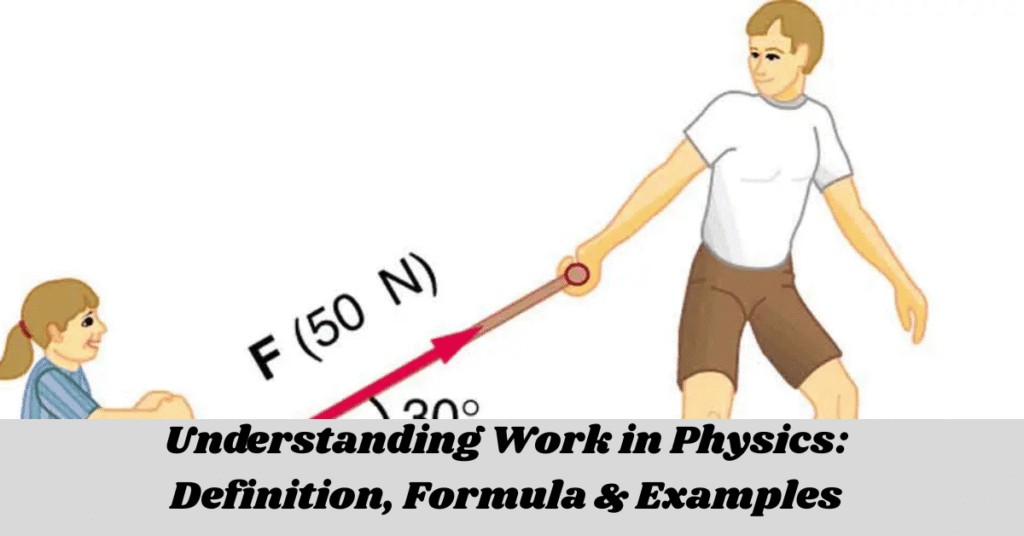
In the simplest terms, work in physics refers to the energy transferred when a force is applied to an object, causing it to move in the direction of the applied force. Work is done when there is a displacement of the object as a result of the force. However, if an object doesn’t move, no work is done, even if a force is applied.
Work Physics Definition
The definition of work in physics can be described as the transfer of energy that occurs when a force causes an object to move. This energy transfer can be calculated using the formula for work, which we’ll discuss shortly.
In essence, work in physics involves both a force and a displacement. The direction of both the force and the movement must be the same for work to occur.
The Formula for Work in Physics
The formula for calculating work in physics is relatively simple:
W=F⋅d⋅cos(θ)W = F \cdot d \cdot \cos(\theta)
Where:
-
WW is the work done (in joules, J)
-
FF is the force applied (in newtons, N)
-
dd is the displacement of the object (in meters, m)
-
θ\theta is the angle between the force and the displacement vectors
Explanation of the Work Formula:
-
Force (F): This is the push or pull applied to an object. It is measured in newtons (N).
-
Displacement (d): The distance the object moves while the force is applied, measured in meters (m).
-
Cosine of the angle (cos(θ)\cos(\theta)): This part of the formula accounts for the direction of the force. If the force and displacement are in the same direction, θ=0∘\theta = 0^\circ, and the formula simplifies to W=F⋅dW = F \cdot d.
Units for Work in Physics:
The unit of work in physics is the joule (J), where:
-
1 joule = 1 newton meter (N·m)
How to Calculate Work in Physics
Now that you understand the formula, let’s go through how to calculate work in physics with an example.
Example 1: Pushing a Box
Let’s say you’re pushing a box with a force of 10 N across a floor. If the box moves 5 meters, and the force is applied in the same direction as the movement:
W=10 N⋅5 m=50 JW = 10 \, N \cdot 5 \, m = 50 \, J
This means 50 joules of work have been done.
Example 2: Lifting an Object
If you lift a 20 kg box vertically with a force equal to its weight (approximately 200 N), and you lift it 2 meters:
W=200 N⋅2 m=400 JW = 200 \, N \cdot 2 \, m = 400 \, J
So, 400 joules of work have been done to lift the box.
Different Types of Work in Physics
Net Work in Physics
Net work refers to the total work done when multiple forces act on an object. If multiple forces are applied in different directions, you calculate the net work by summing the individual works from each force.
Negative Work in Physics
Negative work occurs when the force applied to an object acts in the opposite direction of the object’s motion. For instance, when a person is pushing a box but the frictional force is trying to stop it, the work done by friction is negative.
In mathematical terms, if the angle between the force and the displacement is greater than 90°, the cosine value becomes negative, and so does the work.
Example of Negative Work
If you’re pulling a sled with a force at an angle opposite to the direction the sled is moving, friction is doing negative work to slow it down.
How Does a Vacuum Work Physics?
A vacuum cleaner is a fascinating example of work in action. The physics behind a vacuum cleaner is simple: it applies a force to air particles, creating suction, and moves dirt and dust from one place to another. In physics terms, the vacuum cleaner does work by moving air (the displacement) and creating a force strong enough to overcome the resistance of dust particles.
How Do Noise-Canceling Headphones Work Physics?
Noise-canceling headphones work by using sound waves to cancel out unwanted noise. The work in physics behind this technology involves the use of sound waves that are the exact opposite (or “antiphase”) of the unwanted noise. The force of these sound waves interacts with the noise and reduces it, making it seem as though no noise is present. This is an excellent example of how physics is used in everyday life.
Frequently Asked Questions
What is the definition of work in physics?
Work in physics is defined as the energy transferred when a force causes an object to move in the direction of the force.
How do you calculate work in physics?
To calculate work in physics, use the formula W=F⋅d⋅cos(θ)W = F \cdot d \cdot \cos(\theta), where FF is the force, dd is the displacement, and θ\theta is the angle between the force and displacement.
What is the unit of work in physics?
The unit of work in physics is the joule (J), where 1 joule equals 1 newton meter.
Can work be negative in physics?
Yes, work can be negative when the applied force acts in the opposite direction of the object’s motion.
Conclusion
Understanding work in physics is crucial for grasping many fundamental principles of the physical world. Whether it’s lifting an object, the function of a vacuum cleaner, or how noise-canceling headphones work, physics is everywhere around us. The key takeaway is that work involves the transfer of energy, and it’s governed by the forces acting on an object.
For more information on related topics, feel free to explore our articles on force, energy, and motion!