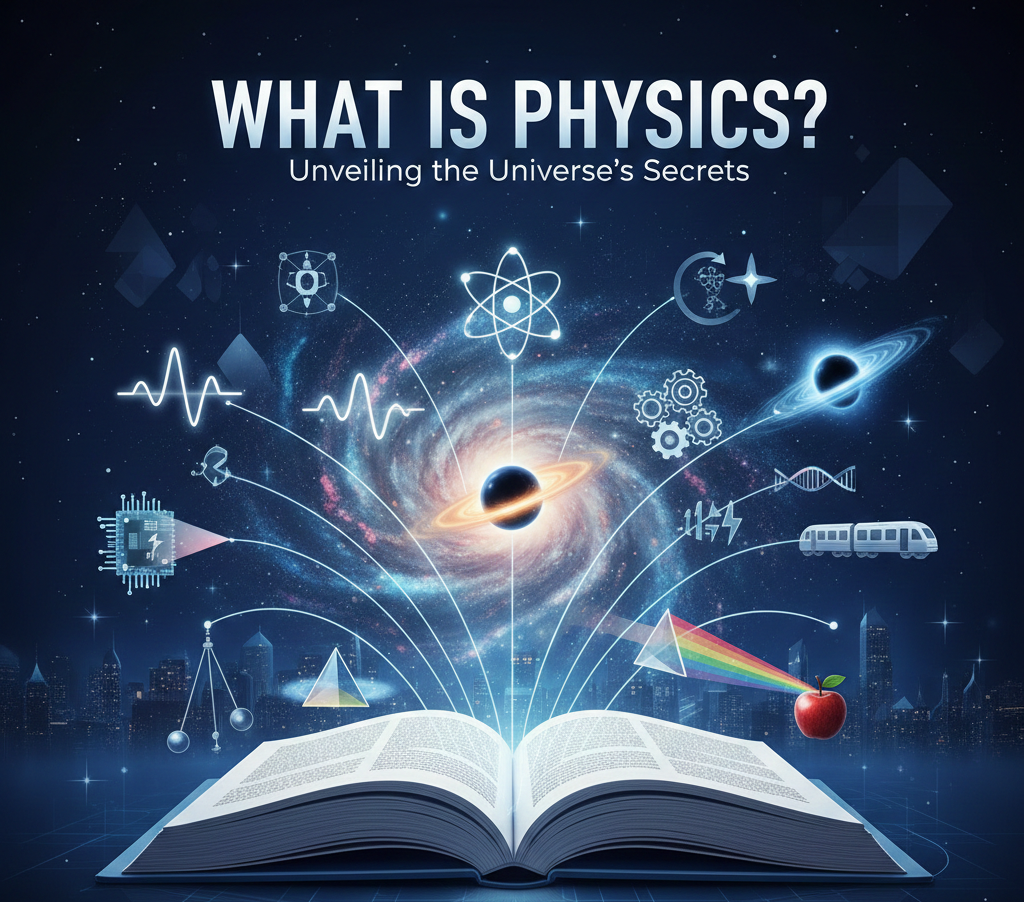

Have you ever wondered why the sky is blue, how your phone sends signals, or what keeps planets moving in space? The answer to all of these questions lies in physics. Simply put, physics is the branch of science that studies matter, energy, motion, space, and time, along with how they interact with each other.
From the smallest particles inside atoms to massive galaxies across the universe, physics helps us understand how everything works. In this article, we’ll break down what is physics, its branches, why it matters, and how it shapes the modern world—all in a clear, conversational way.
What Is Physics in Simple Words?
Physics is the science of nature. It explains:
-
How things move
-
Why objects fall
-
How energy flows
-
How light, sound, and electricity work
At its core, physics asks questions like:
-
Why does this happen?
-
How does it work?
-
What laws control it?
Unlike memorizing facts, physics is about understanding patterns and laws that govern the universe.
The Origin and Meaning of Physics
The word physics comes from the Greek word “physis,” meaning nature. Ancient thinkers like Aristotle and later scientists like Galileo and Newton laid the foundation of physics by observing nature and experimenting with it.
Over time, physics evolved from philosophical ideas into a precise, mathematical science that drives modern technology and innovation.
Why Is Physics Important?
Physics isn’t just a school subject—it’s everywhere in daily life. Without physics, modern civilization wouldn’t exist.
Here’s why physics is important:
-
It explains natural phenomena like gravity, heat, and waves
-
It forms the basis of engineering and technology
-
It helps develop medical equipment such as X-rays and MRI machines
-
It drives innovation in energy, transportation, and communication
In short, physics turns curiosity into practical solutions.
Major Branches of Physics
Physics is a vast field, so it’s divided into several branches. Each one focuses on a specific aspect of the physical world.
Classical Physics
Classical physics deals with everyday objects and phenomena we can see.
Key areas include:
-
Mechanics: Motion, force, and energy
-
Thermodynamics: Heat and temperature
-
Optics: Light and vision
-
Acoustics: Sound and waves
This branch explains things like how cars move or how bridges stay stable.
Modern Physics
Modern physics explores phenomena at extremely small or large scales.
Important fields include:
-
Quantum Physics: Behavior of particles like electrons and photons
-
Relativity: Space, time, and gravity (Einstein’s theories)
-
Nuclear Physics: Structure and behavior of atomic nuclei
Modern physics powers technologies like semiconductors, lasers, and nuclear energy.
Applied Physics
Applied physics focuses on using physical principles to solve real-world problems.
Examples include:
-
Medical physics
-
Engineering physics
-
Electronics and materials science
This is where physics meets practical innovation.
Core Concepts in Physics You Should Know
To truly understand what is physics, it helps to know its fundamental ideas.
Matter and Energy
Everything around us is made of matter, and energy allows matter to move or change.
Force and Motion
Forces like gravity and friction affect how objects move or stay at rest.
Space and Time
Physics explains how distance and time are connected, especially at high speeds.
Laws and Theories
Physics relies on laws (like Newton’s laws) and theories (like relativity) to describe reality.
Physics in Everyday Life
You interact with physics more than you realize.
-
Using a smartphone involves electricity, magnetism, and waves
-
Cooking uses heat transfer and thermodynamics
-
Driving a car depends on mechanics and friction
-
Listening to music involves sound waves and vibrations
Even walking is an example of physics in action.
Physics vs Other Sciences
Physics is often called the foundation of science because it supports other disciplines.
-
Chemistry relies on atomic physics
-
Biology uses principles of mechanics and energy
-
Astronomy is deeply rooted in physics
While other sciences study specific systems, physics focuses on universal laws.
Is Physics Hard to Learn?
Physics has a reputation for being difficult, but that depends on how it’s taught.
Physics becomes easier when:
-
Concepts are explained visually
-
Math is introduced step by step
-
Real-life examples are used
With the right approach, physics can be logical, fascinating, and even fun.
Skills You Gain by Studying Physics
Learning physics builds valuable skills beyond the classroom.
-
Problem-solving
-
Logical thinking
-
Analytical reasoning
-
Mathematical confidence
These skills are useful in careers like engineering, data science, medicine, and technology.
Common Misconceptions About Physics
Let’s clear up a few myths.
-
“Physics is only about math.”
Math is a tool, not the goal. Understanding comes first. -
“Only geniuses can learn physics.”
Anyone can learn physics with patience and practice. -
“Physics has no real-life use.”
Almost all modern technology is based on physics.
FAQs About What Is Physics
What is physics in one sentence?
Physics is the science that studies matter, energy, motion, space, and time, and how they interact.
Why should students study physics?
Physics helps students understand the world, develop problem-solving skills, and prepare for technical careers.
What are the main branches of physics?
The main branches are classical physics, modern physics, and applied physics.
Is physics related to mathematics?
Yes, physics uses mathematics to describe natural laws, but the concepts come first.
Can physics explain everything?
Physics explains many natural phenomena, but it often works alongside chemistry, biology, and other sciences.
Also Read: Physics
Conclusion: Why Physics Truly Matters
So, what is physics? It’s more than equations and formulas—it’s a way of understanding the universe. Physics explains how things move, why energy flows, and how the laws of nature shape our lives.
Whether you’re a student, a curious learner, or someone exploring science for the first time, physics opens the door to deeper thinking and endless discovery. If this topic sparked your interest, consider exploring related areas like mechanics, quantum physics, or real-world applications of physics to see just how powerful this science really is.