
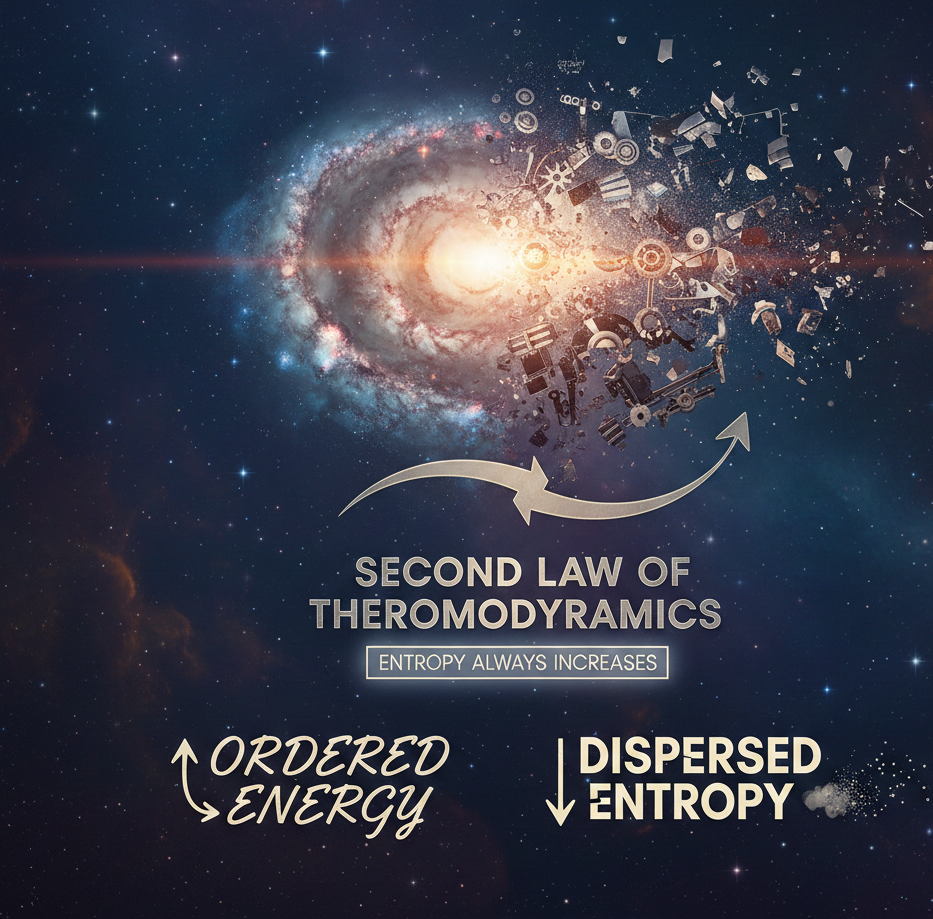

If you’ve ever wondered why hot coffee cools down on its own but never heats up by sitting on a table, you’ve already encountered the second law of thermodynamics in action. Simply put, the second law of thermodynamics states that energy transformations are not 100% efficient and that the disorder of a system—known as entropy—tends to increase over time.
This fundamental principle governs everything from engines and refrigerators to living organisms and the fate of the universe. In this article, we’ll break down what the second law of thermodynamics really means, why it matters, and how it shows up in everyday life—without the confusing jargon.
Understanding the Second Law of Thermodynamics in Simple Terms
At its core, the second law of thermodynamics explains why natural processes have a preferred direction.
Energy doesn’t just move around randomly. When energy is transferred or converted, some of it becomes less useful, usually spreading out as heat. This loss of usable energy is unavoidable.
In everyday language, the law tells us:
-
You can’t get something for nothing
-
Energy naturally spreads out
-
Systems move from order to disorder unless energy is added
The Formal Statement of the Second Law of Thermodynamics
There are several scientifically accepted ways to state the second law. The most common version is:
The entropy of an isolated system always increases over time or remains constant in ideal cases.
That might sound abstract, so let’s unpack it.
What Is an Isolated System?
An isolated system:
-
Does not exchange energy or matter with its surroundings
-
Is completely closed off from the outside world
The universe itself is often considered the ultimate isolated system.
What Is Entropy?
Entropy is a measure of:
-
Disorder
-
Randomness
-
Energy dispersal
Higher entropy means energy is more spread out and harder to use for work.
Why Entropy Always Increases
One of the most important ideas behind the second law of thermodynamics is irreversibility.
Natural processes tend to go in one direction:
-
Ice melts in a warm room
-
Heat flows from hot objects to cold ones
-
A shattered glass doesn’t reassemble itself
These processes increase entropy. Reversing them would require external energy—and even then, total entropy still increases overall.
Everyday Examples of the Second Law of Thermodynamics
You don’t need a laboratory to see this law in action. It’s happening all around you.
Common Real-Life Examples
-
Hot drinks cool down: Heat spreads into the surrounding air
-
Car engines: Not all fuel energy becomes motion; much is lost as heat
-
Messy rooms: Disorder increases unless effort (energy) is applied
-
Batteries draining: Stored energy disperses and becomes less useful
These examples highlight a key idea: energy quality degrades over time.
Second Law of Thermodynamics and Heat Engines
The second law is especially important in understanding machines.
Why No Engine Is 100% Efficient
According to the second law:
-
Some energy is always lost as waste heat
-
No heat engine can convert all heat into useful work
This explains why:
-
Cars waste energy through exhaust and friction
-
Power plants release heat into the environment
-
Perpetual motion machines are impossible
Can Entropy Ever Decrease?
This is a common point of confusion.
Yes, entropy can decrease locally, but only if energy is added from outside.
For example:
-
Living organisms maintain order by consuming energy
-
Refrigerators move heat from cold to hot using electricity
However, when you include the surroundings, total entropy still increases, keeping the second law intact.
Why the Second Law of Thermodynamics Is So Important
The second law isn’t just a physics concept—it has massive implications.
Fields Influenced by the Second Law
-
Physics and chemistry
-
Engineering and energy systems
-
Climate science
-
Biology and evolution
-
Cosmology and the fate of the universe
It even gives rise to the idea of the “arrow of time”, explaining why time moves forward and not backward.
Common Misconceptions About the Second Law
Let’s clear up a few myths.
-
“Entropy means chaos everywhere”
Not exactly. It means energy spreading out, not total randomness. -
“Life violates the second law”
False. Life uses external energy (like sunlight) to maintain order. -
“Entropy always increases quickly”
The rate varies depending on the system and conditions.
FAQs About the Second Law of Thermodynamics
What does the second law of thermodynamics state in simple words?
It states that energy naturally spreads out and becomes less useful over time, and total disorder (entropy) always increases.
Why is the second law of thermodynamics important?
It explains why processes are irreversible, why engines aren’t perfectly efficient, and why perpetual motion machines cannot exist.
Does the second law of thermodynamics apply to living organisms?
Yes. Living systems maintain order by consuming energy, which increases entropy in their surroundings.
Can entropy ever decrease?
Entropy can decrease in a specific system, but only if the total entropy of the system plus its surroundings increases.
Is the second law of thermodynamics ever violated?
No. All experimental evidence supports it, making it one of the most reliable laws in science.
Conclusion: The Big Picture Behind the Second Law
So, what does the second law of thermodynamics state? It tells us that energy transformations are inherently inefficient and that entropy—the measure of energy dispersal—always increases in an isolated system. This simple idea explains why heat flows in one direction, why machines waste energy, and even why time itself moves forward.
Understanding this law helps you see the world more clearly, from everyday appliances to the universe as a whole. If you’re curious to go deeper, consider exploring related topics like entropy, heat engines, or the laws of thermodynamics as a whole—each one adds another layer to this fascinating story of energy and order.