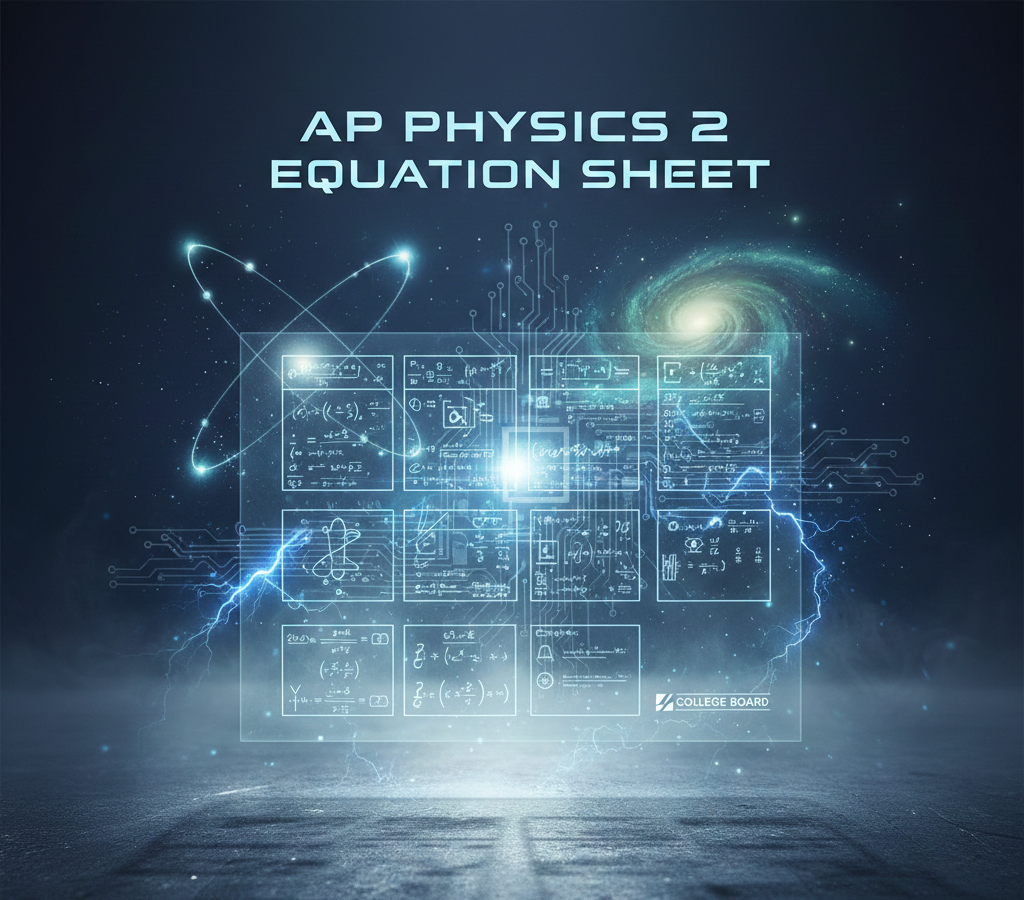

If you’re gearing up for AP Physics 2, one of the best tools in your study arsenal is a well-organized AP Physics 2 equation sheet. This sheet isn’t just a list of formulas—it’s your roadmap to solving problems quickly, reviewing concepts efficiently, and boosting your exam confidence.
In this guide, we’ll break down everything you need to know about the AP Physics 2 equation sheet, from key formulas to tips on using it effectively. Whether you’re a first-time test-taker or looking to improve your score, this article will help you navigate the exam with ease.
What Is the AP Physics 2 Equation Sheet?
The AP Physics 2 equation sheet is a reference tool provided by the College Board for the AP Physics 2 exam. It contains essential formulas for topics such as:
-
Fluid mechanics
-
Thermodynamics
-
Electricity and magnetism
-
Optics
-
Modern physics
Unlike AP Physics 1, AP Physics 2 covers more advanced topics, which makes having a clear, concise equation sheet even more important. The sheet allows you to focus on applying concepts instead of memorizing every single formula.
Key Sections of the AP Physics 2 Equation Sheet
To make the most of your study time, it’s important to understand the main sections of the AP Physics 2 equation sheet. Here’s a breakdown:
1. Fluids and Hydrodynamics
-
Density: ρ=mV\rho = \frac{m}{V}
-
Pressure: P=FAP = \frac{F}{A}
-
Hydrostatic Pressure: P=P0+ρghP = P_0 + \rho g h
-
Buoyant Force: Fb=ρVgF_b = \rho V g
-
Continuity Equation: A1v1=A2v2A_1 v_1 = A_2 v_2
-
Bernoulli’s Equation: P+12ρv2+ρgh=constantP + \frac{1}{2}\rho v^2 + \rho g h = \text{constant}
2. Thermodynamics
-
First Law of Thermodynamics: ΔU=Q−W\Delta U = Q – W
-
Ideal Gas Law: PV=nRTPV = nRT
-
Work Done by Gas: W=PΔVW = P \Delta V
-
Heat Transfer: Q=mcΔTQ = mc\Delta T
-
Efficiency of a Heat Engine: η=WQH\eta = \frac{W}{Q_H}
3. Electricity and Magnetism
-
Coulomb’s Law: F=kq1q2r2F = k\frac{q_1q_2}{r^2}
-
Electric Field: E=Fq=kqr2E = \frac{F}{q} = k\frac{q}{r^2}
-
Ohm’s Law: V=IRV = IR
-
Resistors in Series: Rtotal=R1+R2+…R_\text{total} = R_1 + R_2 + \dots
-
Resistors in Parallel: 1Rtotal=1R1+1R2+…\frac{1}{R_\text{total}} = \frac{1}{R_1} + \frac{1}{R_2} + \dots
-
Magnetic Force on a Moving Charge: F=qvBsinθF = qvB\sin\theta
4. Optics
-
Lens Equation: 1f=1do+1di\frac{1}{f} = \frac{1}{d_o} + \frac{1}{d_i}
-
Magnification: M=hiho=−didoM = \frac{h_i}{h_o} = -\frac{d_i}{d_o}
-
Snell’s Law: n1sinθ1=n2sinθ2n_1 \sin\theta_1 = n_2 \sin\theta_2
-
Diffraction and Interference: nλ=dsinθn\lambda = d \sin\theta
5. Modern Physics
-
Photoelectric Effect: Kmax=hf−ϕK_\text{max} = hf – \phi
-
Energy of a Photon: E=hf=hcλE = hf = \frac{hc}{\lambda}
-
Radioactive Decay: N=N0e−λtN = N_0 e^{-\lambda t}
Tips for Using Your AP Physics 2 Equation Sheet Effectively
Having the formulas is one thing; using them effectively is another. Here are some tips to make the equation sheet work for you:
-
Familiarize Yourself Early – Don’t wait until the exam. Practice with the equation sheet while doing homework and past AP problems.
-
Understand, Don’t Memorize – Know how formulas are derived and what each term represents. This makes solving novel problems much easier.
-
Highlight Frequently Used Formulas – Use color-coding or symbols to mark the formulas you reference the most.
-
Practice Under Timed Conditions – Simulate exam conditions with your equation sheet to improve speed and accuracy.
-
Create Shortcuts – For multi-step problems, write quick notes or rearranged formulas to save time.
Common Mistakes to Avoid
Even with a good AP Physics 2 equation sheet, students can make mistakes:
-
Ignoring Units – Always check that your units are consistent.
-
Overcomplicating Simple Problems – Use the simplest applicable formula.
-
Not Practicing with the Sheet – Treating it as a crutch instead of a tool can backfire.
FAQs About the AP Physics 2 Equation Sheet
Q1: Can I bring my own equation sheet to the AP Physics 2 exam?
A: No, the College Board provides a standardized equation sheet for the exam. Familiarize yourself with it before the test.
Q2: Does the equation sheet cover every formula I need?
A: It includes the most essential formulas, but you still need to understand how to apply them and know underlying concepts.
Q3: How should I study with the equation sheet?
A: Practice solving problems with the sheet in front of you. Focus on applying formulas, not memorizing them.
Q4: Are there differences between the AP Physics 1 and 2 equation sheets?
A: Yes, AP Physics 2 includes advanced topics like thermodynamics, fluids, optics, and modern physics, which aren’t in AP Physics 1.
Conclusion
The AP Physics 2 equation sheet is more than a list of formulas—it’s your roadmap to exam success. By understanding each section, practicing consistently, and using it strategically, you can improve both speed and accuracy on the test. Take time to familiarize yourself with the sheet, highlight key formulas, and solve problems using it as your guide.
Mastering this sheet not only boosts your confidence but also ensures you’re ready to tackle any AP Physics 2 question with ease. Start practicing today, and turn your equation sheet into your ultimate exam advantage!