
Introduction
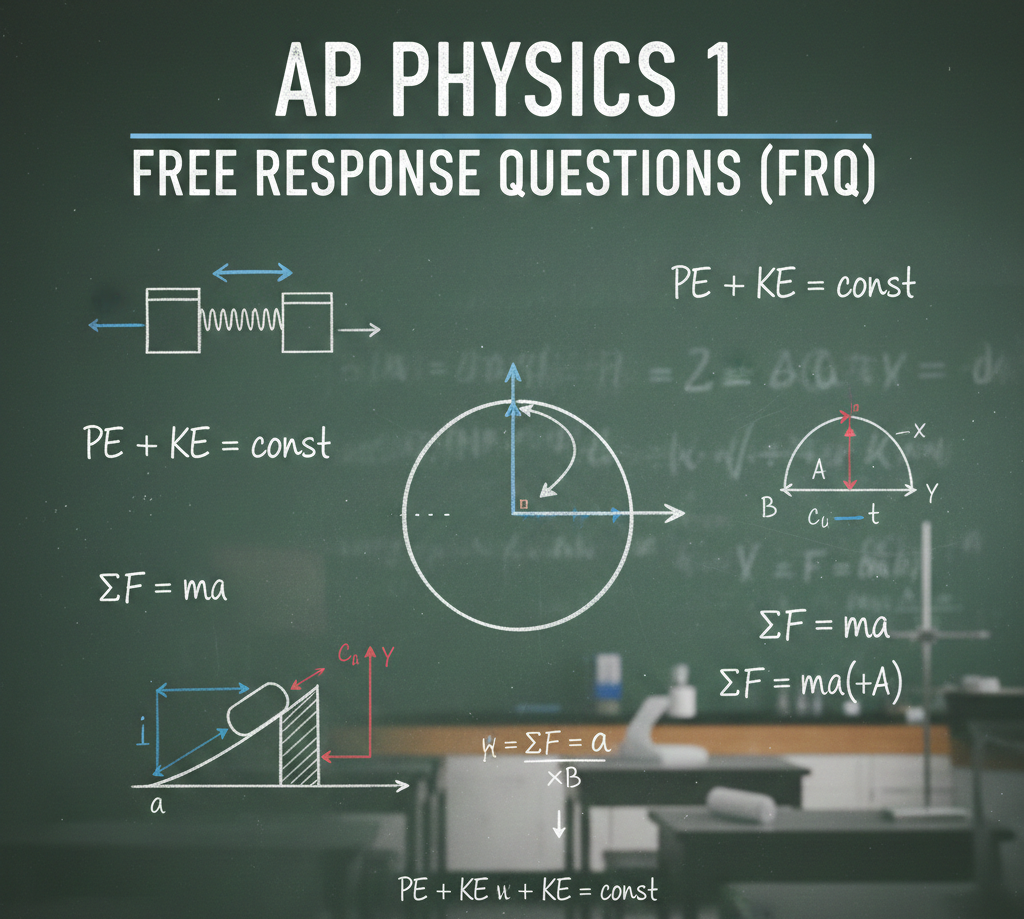
AP Physics 1 can be a challenging yet rewarding course for high school students. One of the most important components of the exam is the Free Response Questions (FRQ). These questions test not only your understanding of physics concepts but also your ability to communicate them clearly and concisely. If you’re aiming to score well, it’s crucial to approach the AP Physics 1 FRQ with a solid strategy and clear structure. In this guide, we’ll explore the key strategies and tips to tackle these questions effectively, boosting your chances of success.
What Is the AP Physics 1 FRQ?
The AP Physics 1 FRQ section consists of a set of complex, open-ended questions designed to assess your problem-solving abilities, critical thinking, and conceptual understanding. Unlike multiple-choice questions, these require you to explain your reasoning, show your work, and demonstrate a deep understanding of physics principles. The questions typically cover topics such as mechanics, waves, electricity, and Newtonian physics.
Key Strategies for Tackling AP Physics 1 FRQ
To excel in the AP Physics 1 FRQ section, it’s essential to have a strategic approach. Here are some tips to help you perform at your best:
1. Understand the Scoring Guidelines
-
Each AP Physics 1 FRQ is graded based on a rubric that awards points for correct answers, clear reasoning, and proper use of physics principles. Understanding how your responses will be evaluated can help you focus on providing thorough and well-structured answers.
2. Read the Question Carefully
-
Before jumping into solving a problem, read the question carefully. Look for key terms like “explain,” “derive,” or “calculate” to understand what is being asked. Identifying these terms will guide how you structure your response.
3. Show All Your Work
-
One of the most critical elements in any FRQ is showing your work. Whether it’s a calculation or a conceptual explanation, providing a step-by-step breakdown of your thought process will not only help the graders follow your reasoning but also ensure you get partial credit if you make a mistake.
4. Use Diagrams and Visuals
-
Physics is a highly visual subject. If applicable, include diagrams to clarify the problem and your solution. Labeling forces, vectors, or important points can often make a complex question easier to understand and answer.
5. Stay Organized
-
Structure your response in a clear, logical order. Start by identifying the knowns and unknowns, write out your formulas, and then proceed to solve the problem. A well-organized answer will make it easier for graders to award you points.
Common Types of AP Physics 1 FRQ Questions
To prepare effectively, it’s helpful to know the types of questions you’re likely to encounter. Here are some common question types:
1. Problem-Solving Questions
-
These questions typically involve calculations where you need to apply equations to solve for unknown variables. You may be asked to find acceleration, velocity, or force, often using Newton’s Laws or principles of motion.
2. Conceptual Questions
-
Conceptual questions require you to explain a physics principle or describe how a system works. These types of questions assess your understanding of the theory behind the physics.
3. Experimental Questions
-
Experimental questions test your ability to design an experiment or analyze data from an experiment. These questions often involve concepts like force, motion, or energy conservation.
AP Physics 1 FRQ Tips: How to Maximize Your Score
Here are some additional tips to make sure you score as high as possible on your AP Physics 1 FRQ:
1. Don’t Rush Your Answer
-
Take your time to ensure you understand each part of the question and can explain your reasoning clearly. A rushed answer might overlook important details and cost you valuable points.
2. Practice, Practice, Practice
-
The more you practice, the better you’ll get at tackling the AP Physics 1 FRQ. Use past exams and practice problems to familiarize yourself with the types of questions you’ll face.
3. Review Physics Principles Regularly
-
Regularly reviewing key physics principles, formulas, and concepts will ensure that you have the foundational knowledge to approach the FRQs with confidence. Be sure to focus on Newton’s Laws, energy conservation, and rotational dynamics.
Frequently Asked Questions
What is the best way to study for the AP Physics 1 FRQ?
-
The best way to study for the AP Physics 1 FRQ is to practice as many past questions as possible. Focus on understanding the concepts, solving problems step by step, and improving your writing skills to clearly communicate your reasoning.
How do I improve my response clarity on the FRQ?
-
Improving response clarity comes down to organization and explanation. Start by breaking down the problem, showing all relevant work, and providing clear explanations for each step. Use bullet points or numbered lists where necessary to keep your answer organized.
How are AP Physics 1 FRQs graded?
-
AP Physics 1 FRQs are graded based on a point system. You earn points for correct answers, correct units, clear reasoning, and proper application of physics principles. Partial credit is awarded for correct steps even if the final answer is wrong.
Conclusion
The AP Physics 1 FRQ section can be a daunting part of the exam, but with the right preparation, you can excel. By practicing past questions, understanding the scoring guidelines, and providing clear, well-organized responses, you’ll be on your way to mastering this section. Remember, the key is to approach each question methodically and demonstrate a deep understanding of the underlying physics principles. Best of luck in your preparation!