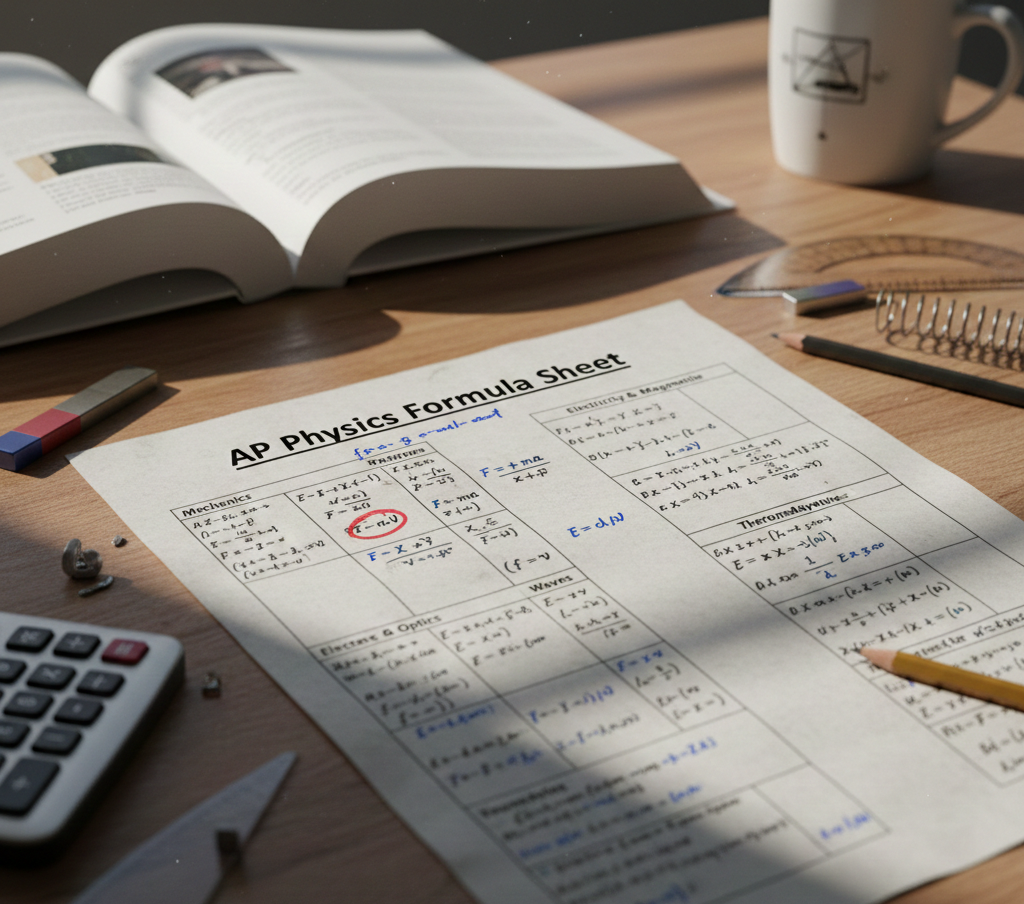

If you’re gearing up for the AP Physics exam, having a solid formula sheet can make all the difference between guessing and confidently solving problems. Whether you’re tackling Newton’s laws, electricity, or modern physics, this guide is designed to give you a concise and effective AP Physics formula sheet, focusing on the most important equations you need to memorize. Let’s dive in and help you organize these formulas so you can approach your test with ease!
The Basics of AP Physics
Before diving into the formulas, it’s essential to understand the key areas of AP Physics. The exam tests your understanding of both conceptual and mathematical physics across various topics, such as:
-
Mechanics: Motion, forces, energy, momentum
-
Electricity and Magnetism: Charges, circuits, electromagnetic fields
-
Waves and Optics: Sound waves, light, and interference
-
Thermodynamics: Heat, energy conservation, and laws of thermodynamics
-
Modern Physics: Relativity, quantum mechanics, atomic models
Having a formula sheet that covers these topics can help you quickly reference essential equations during practice or the exam.
Key Formulas You Must Know
Here’s a breakdown of the most important AP Physics formulas, organized by topic.
Mechanics Formulas
1. Kinematic Equations (for uniform acceleration)
These are crucial for solving motion problems involving velocity, acceleration, and time.
| Formula | Description |
|---|---|
| v=v0+atv = v_0 + at | Final velocity = Initial velocity + (acceleration × time) |
| v2=v02+2a(x−x0)v^2 = v_0^2 + 2a(x – x_0) | Final velocity squared = Initial velocity squared + 2 × acceleration × displacement |
| x=x0+v0t+12at2x = x_0 + v_0t + \frac{1}{2}at^2 | Displacement = Initial position + (initial velocity × time) + 1/2 × acceleration × time² |
| x=x0+12(v+v0)tx = x_0 + \frac{1}{2}(v + v_0)t | Displacement = Initial position + (average velocity × time) |
Forces and Motion
2. Newton’s Laws of Motion
Understanding how forces interact with objects is fundamental for the exam.
| Formula | Description |
|---|---|
| F=maF = ma | Force = mass × acceleration |
| Ffriction=μFNF_{friction} = \mu F_N | Frictional force = coefficient of friction × normal force |
3. Gravitational Force
This is the force that attracts objects toward each other.
| Formula | Description |
|---|---|
| F=Gm1m2r2F = \frac{Gm_1m_2}{r^2} | Gravitational force = (gravitational constant × masses) / distance² |
Work, Energy, and Power
4. Work-Energy Theorem
| Formula | Description |
|---|---|
| W=F⋅d⋅cosθW = F \cdot d \cdot \cos \theta | Work = Force × displacement × cosine of angle between force and displacement |
5. Kinetic Energy
Kinetic energy is the energy of motion.
| Formula | Description |
|---|---|
| KE=12mv2KE = \frac{1}{2}mv^2 | Kinetic energy = 1/2 × mass × velocity² |
6. Potential Energy
Gravitational potential energy is energy due to an object’s position relative to the Earth.
| Formula | Description |
|---|---|
| PE=mghPE = mgh | Potential energy = mass × gravitational acceleration × height |
Electricity and Magnetism Formulas
Electric Forces and Fields
7. Coulomb’s Law
This equation describes the force between two charges.
| Formula | Description |
|---|---|
| F=keq1q2r2F = k_e \frac{q_1q_2}{r^2} | Electric force = Coulomb’s constant × (charge1 × charge2) / distance² |
Electric Circuits
8. Ohm’s Law
| Formula | Description |
|---|---|
| V=IRV = IR | Voltage = Current × Resistance |
9. Power in Circuits
This formula tells you how much power is consumed by a component in a circuit.
| Formula | Description |
|---|---|
| P=IVP = IV | Power = Current × Voltage |
Waves and Optics
10. Wave Speed
| Formula | Description |
|---|---|
| v=fλv = f \lambda | Wave speed = frequency × wavelength |
11. Snell’s Law (Refraction)
| Formula | Description |
|---|---|
| n1sinθ1=n2sinθ2n_1 \sin \theta_1 = n_2 \sin \theta_2 | Refractive index relationship between two media |
Thermodynamics Formulas
12. First Law of Thermodynamics
| Formula | Description |
|---|---|
| ΔU=Q−W\Delta U = Q – W | Change in internal energy = Heat added to the system – Work done by the system |
13. Heat Transfer
| Formula | Description |
|---|---|
| Q=mcΔTQ = mc \Delta T | Heat = mass × specific heat capacity × temperature change |
Modern Physics
14. Einstein’s Mass-Energy Equivalence
| Formula | Description |
|---|---|
| E=mc2E = mc^2 | Energy = mass × speed of light² |
15. Photoelectric Effect
| Formula | Description |
|---|---|
| E=hfE = hf | Energy = Planck’s constant × frequency |
Frequently Asked Questions (FAQs)
1. How do I use an AP Physics formula sheet effectively?
-
Focus on memorizing key formulas, but don’t just rely on the sheet. Practice solving problems to understand how to apply the formulas in different situations.
2. Can I bring my own formula sheet to the AP Physics exam?
-
Yes, the formula sheet is provided during the exam, but it’s helpful to familiarize yourself with it ahead of time to save time.
3. What are the most important formulas to memorize for AP Physics?
-
The most essential formulas include the kinematic equations, Newton’s laws, work-energy theorem, Coulomb’s law, and Ohm’s law.
4. Are there any tips for memorizing the formulas faster?
-
Break them down into categories (mechanics, electricity, etc.), and use flashcards, mnemonic devices, and practice problems to reinforce your memory.
Conclusion: Mastering AP Physics with the Right Formula Sheet
With a comprehensive AP Physics formula sheet, you’ll be equipped to handle the toughest questions during your exam. Whether you’re tackling mechanics, electricity, or thermodynamics, having these formulas at your fingertips can save you valuable time and help you focus on solving the problem. Keep practicing and familiarizing yourself with these formulas, and you’ll be on your way to success in AP Physics!