

Introduction
When preparing for the AP Physics 1 exam, one of the most valuable tools you can have is a solid AP Physics 1 equation sheet. Whether you’re reviewing for the test or looking for a quick reference during your study sessions, knowing how to use this sheet effectively can make a significant difference in your performance. In this guide, we’ll break down the core formulas and provide some key tips to help you understand how to apply them to real exam questions.
What is the AP Physics 1 Equation Sheet?
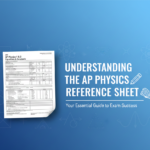
The AP Physics 1 equation sheet is a resource provided by the College Board during the AP Physics 1 exam. It includes a comprehensive list of the formulas and constants that you’ll need to solve various problems on the test. This sheet is your cheat sheet during the exam, but it’s important to note that while the formulas are provided, you’ll need to understand when and how to use them to maximize your score.
Key Sections of the AP Physics 1 Equation Sheet
The equation sheet is divided into several categories, each corresponding to a section of the AP Physics 1 syllabus. Let’s break down the most important sections you’ll find:
1. Kinematics and Motion
This section includes equations for uniform motion, acceleration, and projectile motion, covering concepts like velocity, displacement, and acceleration. The key equations here are:
-
Velocity:
v=v0+atv = v_0 + at -
Displacement:
x=x0+v0t+12at2x = x_0 + v_0t + \frac{1}{2}at^2 -
Final velocity:
v2=v02+2a(x−x0)v^2 = v_0^2 + 2a(x – x_0)
2. Newton’s Laws and Forces
Understanding Newton’s Laws of Motion is critical for solving force-related problems. The equation sheet provides these essential formulas:
-
Force (Newton’s Second Law):
F=maF = ma -
Gravitational Force:
Fg=Gm1m2r2F_g = \frac{Gm_1m_2}{r^2}
3. Work, Energy, and Power
This section focuses on the relationship between work, energy, and power, which is essential for many questions in the exam:
-
Work:
W=F⋅d⋅cos(θ)W = F \cdot d \cdot \cos(\theta) -
Kinetic Energy:
KE=12mv2KE = \frac{1}{2}mv^2 -
Potential Energy:
PE=mghPE = mgh -
Power:
P=WtP = \frac{W}{t}
4. Circular Motion and Gravitation
In this section, you’ll encounter formulas for motion along a circular path and the forces involved:
-
Centripetal Force:
Fc=mv2rF_c = \frac{mv^2}{r} -
Gravitational Potential Energy:
Ug=−Gm1m2rU_g = -\frac{Gm_1m_2}{r}
5. Simple Harmonic Motion
This category covers oscillations and waves, including the equations for spring motion and pendulum motion:
-
Spring Force (Hooke’s Law):
F=−kxF = -kx -
Period of a Pendulum:
T=2πlgT = 2\pi\sqrt{\frac{l}{g}}
How to Use the AP Physics 1 Equation Sheet Effectively
While the equation sheet is helpful, simply having it in front of you won’t guarantee success. Here are some tips for using the sheet effectively during the exam:
1. Understand the Formulas
The equation sheet provides the formulas, but you need to understand how they work. Practice applying these equations to problems so you can recall them quickly during the test.
2. Know Where Each Formula Is Located
Familiarity with the layout of the sheet can save valuable time during the exam. Try to memorize where the most commonly used formulas are so you can access them quickly without wasting time searching.
3. Use Units Wisely
Make sure to always include correct units in your calculations. The equation sheet includes the units for each formula, so pay close attention to them.
4. Practice with Past Papers
Use past AP Physics 1 exams to get a feel for how the formulas are applied in real exam questions. This will also help you get comfortable with working under timed conditions.
Frequently Asked Questions (FAQs)
1. Do I need to memorize the AP Physics 1 equation sheet?
No, you don’t need to memorize the equation sheet, as it’s provided during the exam. However, you should be familiar with the formulas and know how to apply them effectively.
2. Can I bring my own equation sheet to the exam?
No, the equation sheet is provided by the College Board during the exam. You cannot bring your own copy.
3. How should I practice using the equation sheet?
It’s essential to practice with the sheet in hand during your study sessions. Solve problems, use the formulas, and refer to the sheet as necessary. This will help you become familiar with it and improve your speed.
4. What should I do if I forget a formula during the exam?
If you forget a formula during the exam, try to reason through the problem using known concepts or eliminate wrong answers based on the given information. The equation sheet should provide you with the necessary formulas, but your understanding of physics principles is key.
Conclusion
The AP Physics 1 equation sheet is a vital tool that can help guide you through the exam. By becoming familiar with the layout and formulas, and practicing how to apply them in various situations, you’ll be in a much better position to succeed. Remember, while the equation sheet is essential, a deep understanding of the concepts behind the formulas will make all the difference. So, take the time to study, practice, and approach the exam with confidence.