
When it comes to understanding motion in physics, one concept stands out as both fundamental and incredibly useful: the distance formula in physics. Whether you’re calculating how far an object travels or analyzing motion in a 2D plane, mastering this formula can make your physics problems much easier. In this guide, we’ll break down the distance formula, explain how it works, and give practical examples to help you grasp it fully.
What is the Distance Formula in Physics?
In physics, the distance formula is a mathematical equation used to determine the straight-line distance between two points. This is particularly important in kinematics, where understanding how far an object moves is crucial.
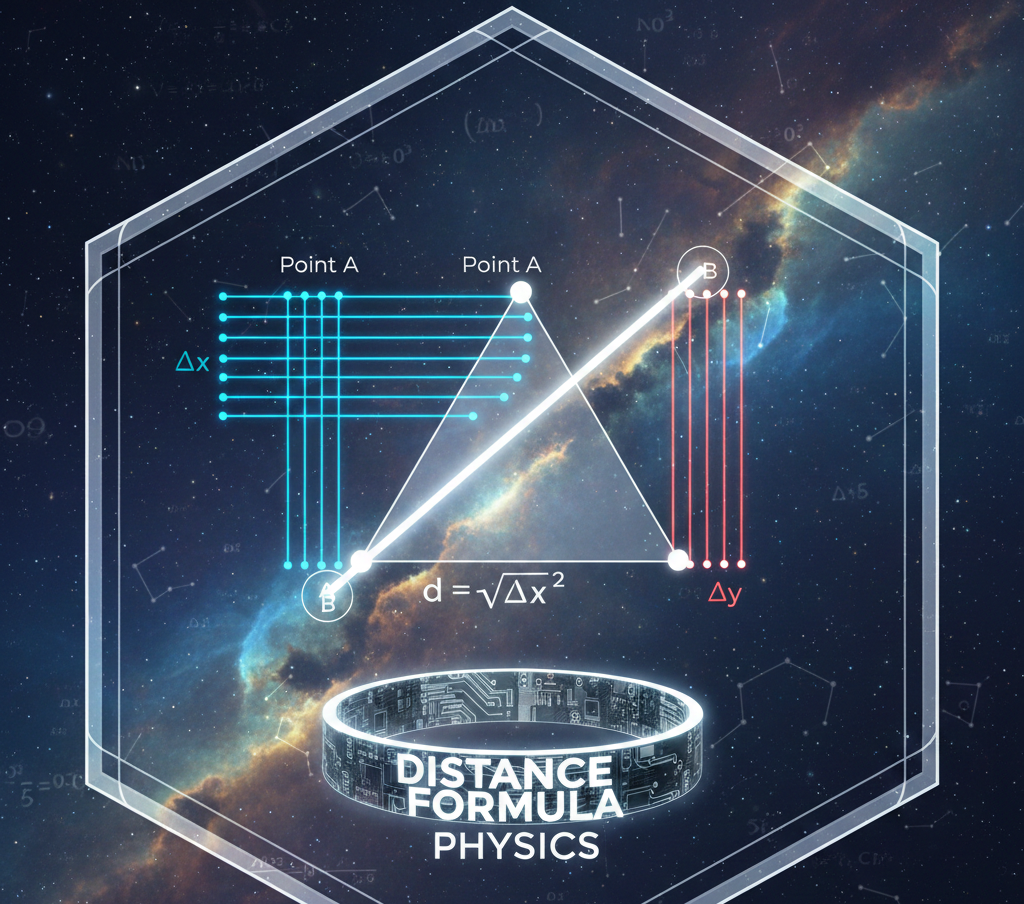
The most commonly used distance formula in a two-dimensional plane is:
d=(x2−x1)2+(y2−y1)2d = \sqrt{(x_2 – x_1)^2 + (y_2 – y_1)^2}
Where:
-
dd = distance between two points
-
(x1,y1)(x_1, y_1) = coordinates of the first point
-
(x2,y2)(x_2, y_2) = coordinates of the second point
This formula comes straight from the Pythagorean theorem. Think of it as calculating the hypotenuse of a right-angled triangle formed by the horizontal and vertical distances between the points.
Why is the Distance Formula Important in Physics?
Understanding the distance formula isn’t just about solving math problems—it has real-world applications in physics:
-
Motion Analysis: Determine how far objects move in straight or curved paths.
-
Projectile Motion: Calculate the exact path of projectiles in two dimensions.
-
Vector Calculations: Helps in understanding displacement and velocity vectors.
-
Engineering & Navigation: Used in designing trajectories and mapping positions.
Basically, if you want to describe movement accurately, this formula is your best friend.
How to Use the Distance Formula: Step-by-Step
Let’s break it down with an example. Suppose you have two points: A(2,3)A(2, 3) and B(5,7)B(5, 7). How do we find the distance between them?
-
Subtract the x-coordinates:
x2−x1=5−2=3x_2 – x_1 = 5 – 2 = 3
-
Subtract the y-coordinates:
y2−y1=7−3=4y_2 – y_1 = 7 – 3 = 4
-
Square the differences:
32=9,42=163^2 = 9, \quad 4^2 = 16
-
Add the squares:
9+16=259 + 16 = 25
-
Take the square root:
25=5\sqrt{25} = 5
So, the distance between points A and B is 5 units.
This method works for any two points in a plane and can be expanded for three-dimensional calculations as well:
d=(x2−x1)2+(y2−y1)2+(z2−z1)2d = \sqrt{(x_2 – x_1)^2 + (y_2 – y_1)^2 + (z_2 – z_1)^2}
Distance vs. Displacement in Physics
It’s easy to confuse distance and displacement, but they are different:
| Term | Definition | Example |
|---|---|---|
| Distance | Total path traveled, scalar quantity | Walking 3 km north, then 4 km east = 7 km |
| Displacement | Straight-line distance from start to end, vector quantity | Straight-line from start to end = 5 km |
The distance formula specifically helps calculate displacement, the shortest path between two points.
Common Mistakes When Using the Distance Formula
Even though the formula is simple, students often make mistakes. Here are some tips to avoid them:
-
Mixing up coordinates: Always ensure you subtract correctly: x2−x1x_2 – x_1 and y2−y1y_2 – y_1.
-
Skipping the square root: The sum of squares is not the distance—take the square root at the end.
-
Confusing distance with displacement: Remember, distance is the actual path traveled; displacement is straight-line.
-
Ignoring units: Keep track of meters, kilometers, or any unit system consistently.
Real-Life Applications of the Distance Formula in Physics
-
Sports Analytics: Calculating how far a football player runs during a game.
-
Astronomy: Measuring distances between stars or planets in space.
-
Navigation: GPS systems use similar formulas to compute distances between locations.
-
Engineering Projects: From bridge construction to drone flight paths, it ensures precise measurements.
FAQs About Distance Formula Physics
Q1: Is the distance formula only for 2D motion?
No. The formula can be extended to 3D motion by including the z-coordinate, making it useful for any spatial calculation.
Q2: Can the distance formula give negative results?
No. Distance is always a positive quantity because it represents the length of a path.
Q3: How is the distance formula different from displacement formula?
Distance measures the total path traveled (scalar), while displacement measures the straight-line distance from start to end (vector).
Q4: Why is the distance formula based on the Pythagorean theorem?
Because it calculates the hypotenuse of a right triangle formed by the horizontal and vertical distances between two points.
Q5: Can I use the distance formula for curved paths?
Directly no, it calculates straight-line distance. For curves, you may need calculus to integrate the path length.
Conclusion
The distance formula in physics is a simple yet powerful tool to measure how far objects move, whether in 2D or 3D space. Understanding this formula can help you solve physics problems, analyze motion, and even apply it to real-world scenarios like navigation, sports, and engineering.
Mastering this concept not only improves your problem-solving skills but also lays the foundation for more advanced physics topics. So grab your coordinates, plug them into the formula, and watch motion come alive on paper!