
Introduction: Understanding Impulse Physics
Impulse physics is a key concept in mechanics, relating to the force applied to an object and the resulting change in its motion. Whether you’re a student preparing for a physics exam or simply curious about how things move, understanding impulse and momentum is crucial. But what exactly does impulse mean in physics? And how can you calculate it?
In this article, we’ll cover everything you need to know about impulse physics, from its definition and formulas to practical examples, calculations, and diagrams. So, if you’re ready to dive into the world of impulse, keep reading!
What is Impulse in Physics?
Impulse in physics refers to the change in momentum of an object when a force acts upon it over a period of time. It’s a vector quantity, meaning it has both magnitude and direction. Essentially, impulse is the force applied to an object and how long it is applied.
Impulse Physics Definition Formula
The formula for impulse is given by:
J=F×ΔtJ = F \times \Delta t
Where:
-
JJ is the impulse
-
FF is the force applied
-
Δt\Delta t is the time duration over which the force is applied
This equation shows that impulse is directly proportional to the force and the time over which it acts. The longer the force is applied, or the greater the force, the larger the impulse.
Impulse Physics and Momentum
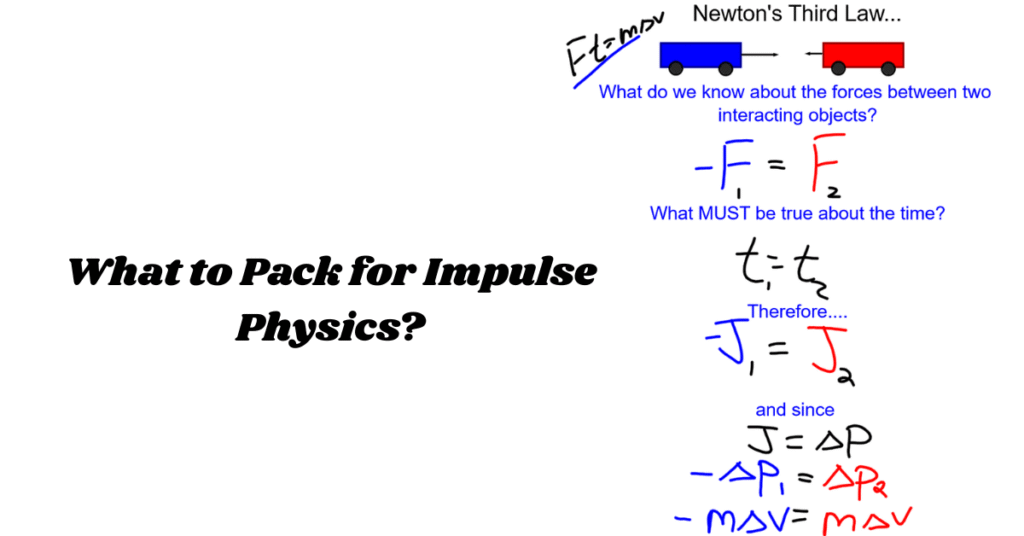
Impulse is closely related to momentum, which is simply the product of an object’s mass and its velocity. The key relationship here is that impulse causes a change in momentum. This is summarized by the impulse-momentum theorem:
J=ΔpJ = \Delta p
Where:
-
Δp\Delta p is the change in momentum
-
JJ is the impulse
Momentum and Impulse in Physics: A Simple Example
To make things clearer, imagine a soccer ball being kicked. The foot applies a force to the ball for a short time, resulting in a change in the ball’s momentum (speed and direction). This is a real-life example of impulse at work. The longer the foot stays in contact with the ball (more time), or the harder the kick (more force), the greater the change in momentum.
How to Find Impulse in Physics
Calculating impulse is straightforward, thanks to the impulse-momentum theorem. You can find impulse by calculating the change in momentum:
J=m×ΔvJ = m \times \Delta v
Where:
-
mm is the mass of the object
-
Δv\Delta v is the change in velocity of the object
How to Calculate Impulse in Physics
To calculate impulse:
-
Find the object’s initial and final velocities.
-
Calculate the change in velocity by subtracting the initial velocity from the final velocity.
-
Multiply by the object’s mass to get the impulse.
For example, if a 5 kg object is moving at 2 m/s and is brought to rest (final velocity = 0), the impulse would be:
J=5 kg×(0−2) m/s=−10 N\cdotpsJ = 5 \, \text{kg} \times (0 – 2) \, \text{m/s} = -10 \, \text{N·s}
The negative sign indicates that the force acted in the opposite direction to the object’s motion.
Impulse Physics Example
Consider a car crash scenario: A 1,000 kg car traveling at 20 m/s hits a barrier and comes to a stop in 0.2 seconds. To calculate the impulse, we use the formula:
J=m×ΔvJ = m \times \Delta v J=1000 kg×(0−20) m/s=−20,000 N\cdotpsJ = 1000 \, \text{kg} \times (0 – 20) \, \text{m/s} = -20,000 \, \text{N·s}
This impulse is what slows the car down, and the force involved can be calculated by dividing the impulse by the time:
F=JΔt=−20,000 N\cdotps0.2 s=−100,000 NF = \frac{J}{\Delta t} = \frac{-20,000 \, \text{N·s}}{0.2 \, \text{s}} = -100,000 \, \text{N}
This massive force explains the impact and why safety features like airbags are important.
Impulse Physics Units
Impulse is measured in Newton-seconds (N·s), which are derived from the force applied (measured in Newtons) and the time (measured in seconds). This unit reflects the amount of momentum change an object experiences during an interaction.
Impulse Physics Diagrams
To better understand impulse physics, it’s helpful to look at diagrams that show force vs. time graphs. In these graphs:
-
The area under the curve represents the impulse.
-
The x-axis typically represents time, and the y-axis represents force.
For example, in a car crash, the force may spike sharply and then quickly drop to zero. The area under this curve is the impulse that brought the car to a stop.
Common Impulse Physics Questions
Q1: What is the difference between impulse and momentum?
Impulse is the change in momentum of an object, while momentum is the quantity of motion the object has at a specific time.
Q2: How is impulse related to force?
Impulse is the product of the applied force and the time over which it acts. A larger force or longer time results in a greater impulse.
Q3: How do you find impulse when the force is not constant?
When the force is not constant, you calculate impulse by integrating the force over the time interval during which the force acts.
Q4: Can impulse be negative?
Yes, impulse can be negative if the force acts in the opposite direction of motion, resulting in a decrease in momentum.
Conclusion: The Importance of Understanding Impulse Physics
Impulse physics plays a critical role in understanding the behavior of objects in motion, particularly in fields like automotive safety, sports, and engineering. By grasping the concept of impulse and how to calculate it, you’re better equipped to analyze real-world scenarios, from car crashes to rocket launches.
If you’re looking to dive deeper into impulse physics, be sure to explore additional topics such as momentum conservation, impulse-momentum diagrams, and the various forces at play in different systems. For more detailed explanations and related examples, check out other articles on physics formulas and concepts!