
Whether you’re gearing up for the AP Physics exam or just want to refresh your knowledge, having a handy equation sheet can make all the difference. Mechanics is one of the core topics in AP Physics, and understanding its key equations is essential for mastering both the multiple-choice and free-response sections. In this guide, we’ll break down the most important mechanics equations, explain how to use them effectively, and offer some tips for success.
Let’s dive into the world of physics equations and make sure you feel confident going into your exam.
What Is the AP Physics Mechanics Equation Sheet?
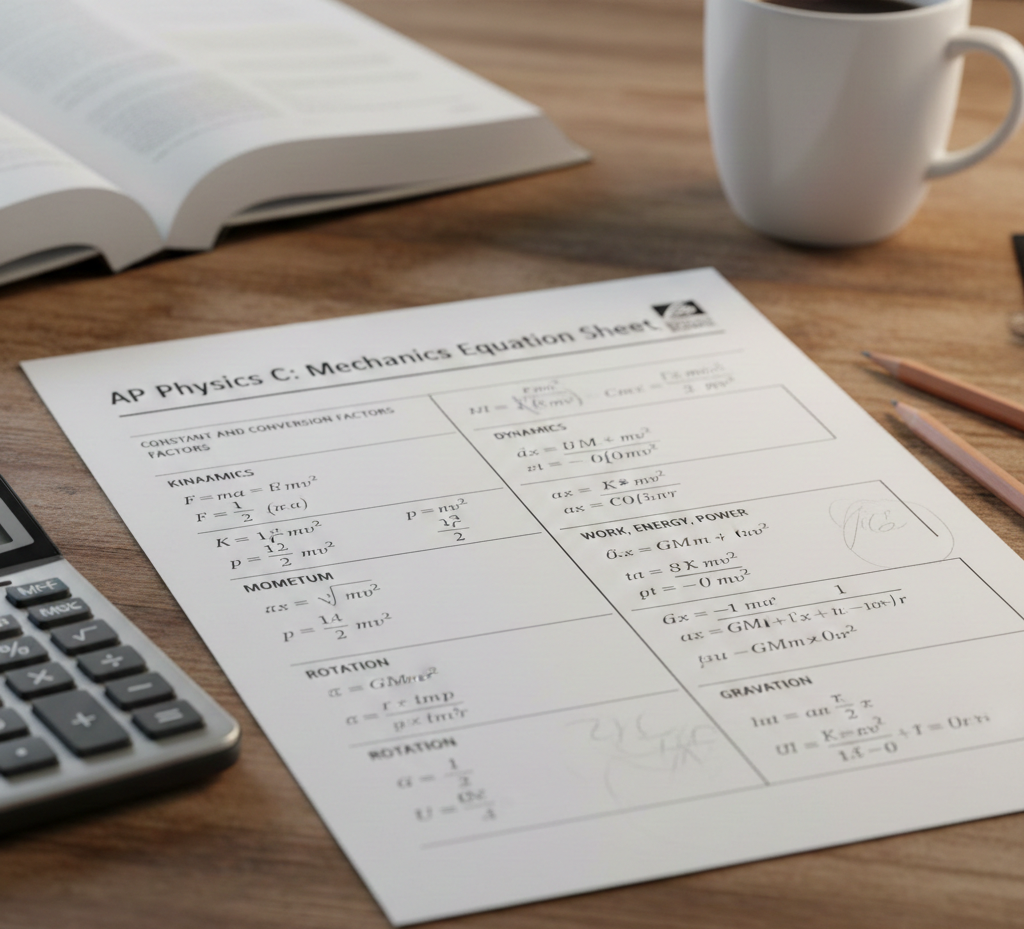
The AP Physics Mechanics equation sheet is a tool provided during the AP exam that contains essential formulas used in solving problems related to mechanics. This sheet is invaluable because it ensures you don’t need to memorize every equation, allowing you to focus more on understanding concepts and applying the formulas effectively.
However, knowing where each formula is located and how to apply them can be a huge advantage, especially in high-pressure test situations.
Key Mechanics Equations in AP Physics
Below is a list of essential mechanics equations that are crucial for your AP Physics exam. We’ve categorized them to make it easier for you to reference during your study sessions.
1. Kinematics Equations
These are the foundational equations used to describe the motion of objects under constant acceleration.
| Equation | Description |
|---|---|
| v=u+atv = u + at | Final velocity (vv) after a time tt with initial velocity uu and acceleration aa |
| s=ut+12at2s = ut + \frac{1}{2} a t^2 | Displacement (ss) for an object moving with constant acceleration |
| v2=u2+2asv^2 = u^2 + 2as | Relates final velocity, initial velocity, acceleration, and displacement |
| s=(u+v)2ts = \frac{(u + v)}{2} t | Average velocity equation for uniformly accelerated motion |
How to Use These Equations: These equations are useful when dealing with objects moving in a straight line under constant acceleration. Whether you’re solving for final velocity or time, knowing which variables you have and which one you need will help you select the right equation.
2. Newton’s Laws of Motion
Newton’s three laws describe the relationship between a body and the forces acting on it.
| Equation | Description |
|---|---|
| F=maF = ma | Force (FF) is the product of mass (mm) and acceleration (aa) |
| ΣF=0\Sigma F = 0 | Net force (ΣF\Sigma F) is zero for an object at rest or moving at constant velocity (Newton’s First Law) |
| Ffriction=μNF_{\text{friction}} = \mu N | Frictional force (FfrictionF_{\text{friction}}) is the product of the coefficient of friction (μ\mu) and the normal force (NN) |
How to Use These Equations: Newton’s laws are fundamental for solving problems that involve forces, including static equilibrium, friction, and dynamics of moving objects.
3. Work, Energy, and Power
These equations are crucial for understanding how energy is transferred or converted in mechanical systems.
| Equation | Description |
|---|---|
| W=Fdcos(θ)W = Fd \cos(\theta) | Work (WW) done by a force (FF) over a displacement (dd) at an angle θ\theta |
| K.E.=12mv2K.E. = \frac{1}{2}mv^2 | Kinetic energy (K.E.K.E.) of an object with mass (mm) and velocity (vv) |
| P=WtP = \frac{W}{t} | Power (PP) is the rate of doing work over time (tt) |
How to Use These Equations: Work-energy principles are key when analyzing mechanical systems, especially when forces cause objects to move or change speed. Power is useful for understanding energy efficiency and rates of work.
4. Circular Motion and Gravitation
Equations for circular motion help describe objects moving in circular paths, and gravitation equations govern forces between masses.
| Equation | Description |
|---|---|
| Fcentripetal=mv2rF_{\text{centripetal}} = \frac{mv^2}{r} | Centripetal force needed for an object of mass mm moving at velocity vv in a circle of radius rr |
| Fgravity=Gm1m2r2F_{\text{gravity}} = \frac{Gm_1 m_2}{r^2} | Gravitational force between two masses (m1,m2m_1, m_2) separated by distance rr |
| g=GMR2g = \frac{GM}{R^2} | Gravitational acceleration (gg) at a distance RR from the center of a planet with mass MM |
How to Use These Equations: These equations are necessary for solving problems related to orbits, gravitational forces, and objects moving in circular paths.
5. Impulse and Momentum
Momentum equations describe the motion of objects in terms of mass and velocity, while impulse relates to the change in momentum.
| Equation | Description |
|---|---|
| p=mvp = mv | Momentum (pp) is the product of mass (mm) and velocity (vv) |
| FΔt=ΔpF\Delta t = \Delta p | Impulse (FΔtF \Delta t) is equal to the change in momentum (Δp\Delta p) |
| J=ΔpJ = \Delta p | Impulse (JJ) is the change in momentum (Δp\Delta p) |
How to Use These Equations: Impulse-momentum relationships are essential for solving problems involving collisions, explosions, or changes in velocity.
How to Use Your AP Physics Mechanics Equation Sheet
Knowing how to use the AP Physics Mechanics equation sheet effectively is essential. Here are some tips:
-
Familiarize Yourself: Before the exam, make sure you understand every formula on the sheet. Knowing where to find each equation will save you time during the exam.
-
Don’t Rely on It Too Much: While the equation sheet is helpful, understanding the concepts behind the equations will allow you to solve problems more quickly and accurately.
-
Practice: The more you practice using these equations in different problems, the easier it will become to recall and apply them during the exam.
FAQs About AP Physics Mechanics Equation Sheet
1. Can I use the AP Physics mechanics equation sheet during the exam?
Yes, you can use the equation sheet during the exam. It’s provided to ensure you don’t need to memorize every formula, allowing you to focus on applying concepts.
2. How should I prepare for the AP Physics exam using the equation sheet?
Familiarize yourself with the equations, practice solving problems, and learn how to quickly identify which formula to use for different scenarios.
3. What’s the best way to memorize the physics formulas?
Understand the relationships between different variables in each formula and practice using them in various problem scenarios to reinforce your memory.
Conclusion
The AP Physics mechanics equation sheet is an invaluable resource, but it’s only effective if you understand how to use the formulas. By familiarizing yourself with the key equations, practicing problems, and learning the concepts behind them, you’ll be well-prepared to tackle your AP Physics exam confidently. Remember, it’s not just about memorizing formulas—it’s about understanding how to apply them. Happy studying!