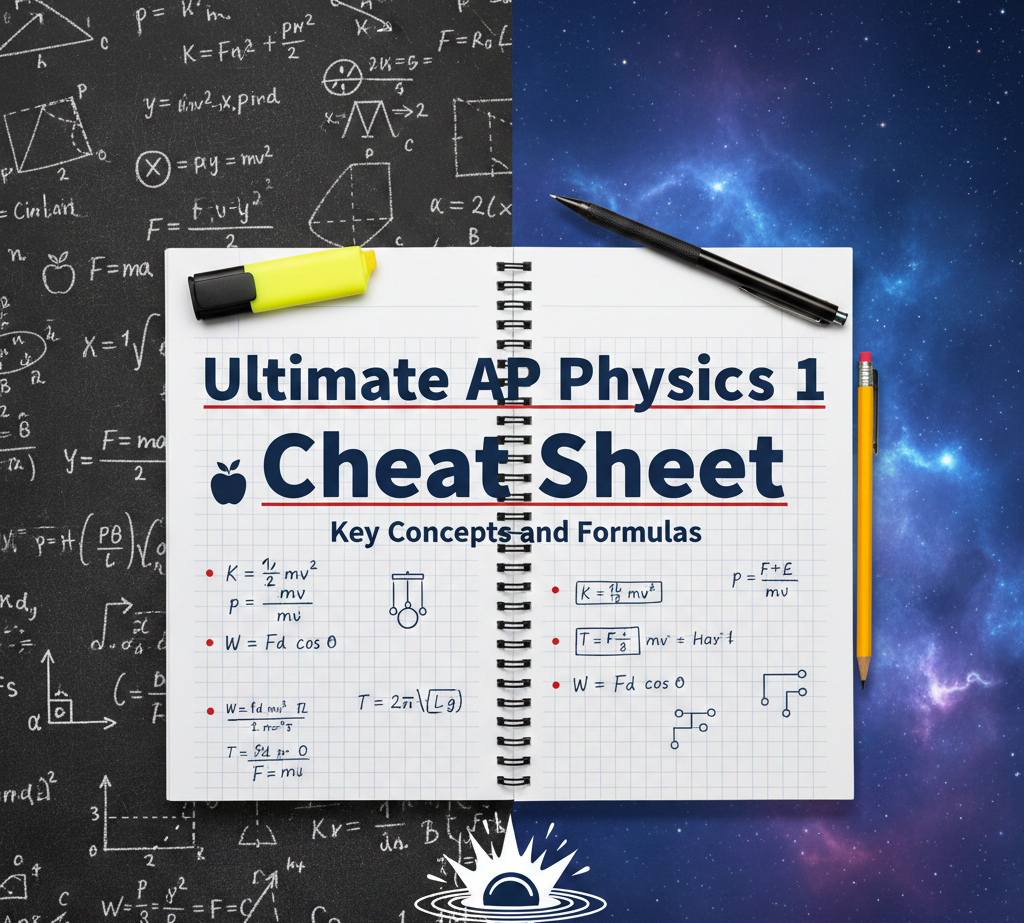

Are you gearing up for the AP Physics 1 exam? You’re not alone! This subject can feel overwhelming, but with the right approach, you can master it. If you’re looking for a quick reference to simplify the process, you’ve found it! In this article, we’ll break down the most important concepts, formulas, and strategies that will help you breeze through your AP Physics 1 exam.
Whether you’re a high school student preparing for the test or someone who wants a refresher, this cheat sheet will serve as a helpful guide for quick study sessions. Let’s dive right in!
Key Concepts for AP Physics 1
AP Physics 1 is designed to test your understanding of the fundamental principles of physics. These include motion, forces, energy, and waves, all of which are essential for answering the exam’s questions effectively.
1. Kinematics (Motion)
-
Key Formulae:
-
v=u+atv = u + at
-
s=ut+12at2s = ut + \frac{1}{2}at^2
-
v2=u2+2asv^2 = u^2 + 2as
-
-
What to Know:
-
Displacement (s): The change in position of an object.
-
Velocity (v): Speed with direction; average and instantaneous velocity.
-
Acceleration (a): The rate of change of velocity.
-
2. Newton’s Laws of Motion
-
First Law (Inertia): An object will remain at rest or in uniform motion unless acted upon by a force.
-
Second Law (F = ma): Force equals mass times acceleration.
-
Third Law (Action and Reaction): For every action, there’s an equal and opposite reaction.
3. Work, Energy, and Power
-
Key Formulae:
-
W=F⋅d⋅cos(θ)W = F \cdot d \cdot \cos(\theta)
-
KE=12mv2KE = \frac{1}{2}mv^2
-
PE=mghPE = mgh
-
P=WtP = \frac{W}{t}
-
-
What to Know:
-
Work (W): Energy transferred when a force acts over a distance.
-
Kinetic Energy (KE): Energy an object has due to its motion.
-
Potential Energy (PE): Energy stored in an object due to its position, typically in a gravitational field.
-
AP Physics 1 Cheat Sheet: Formulas at a Glance
To help you prepare efficiently, here’s a table summarizing the most essential formulas you’ll need to memorize for the AP Physics 1 exam:
| Concept | Formula | Explanation |
|---|---|---|
| Kinematic Equations | v=u+atv = u + at | Final velocity = initial velocity + (acceleration * time) |
| Newton’s Second Law | F=maF = ma | Force = mass * acceleration |
| Work | W=F⋅d⋅cos(θ)W = F \cdot d \cdot \cos(\theta) | Work = force * displacement * cos(angle) |
| Kinetic Energy | KE=12mv2KE = \frac{1}{2}mv^2 | Kinetic energy = (1/2) * mass * velocity^2 |
| Potential Energy | PE=mghPE = mgh | Potential energy = mass * gravity * height |
| Momentum | p=mvp = mv | Momentum = mass * velocity |
| Impulse | J=F⋅ΔtJ = F \cdot \Delta t | Impulse = force * change in time |
This cheat sheet highlights just the most critical formulas. It’s always best to practice applying these formulas in real-world scenarios to understand them fully.
Common Tips and Tricks for AP Physics 1
1. Understand, Don’t Memorize
Physics isn’t about memorizing formulas—it’s about understanding how and why they work. Make sure you understand the principles behind each formula. For example, knowing why F=maF = ma is true will help you solve problems more intuitively.
2. Use Dimensional Analysis
Check the units! If your answer doesn’t make sense dimensionally, something is likely wrong. This will help you spot mistakes before you even finish your calculations.
3. Practice Problems
The best way to get a feel for AP Physics is to practice problems. The more problems you solve, the more comfortable you’ll be with the concepts and the formulas.
FAQs About AP Physics 1
1. What is the hardest part of AP Physics 1?
Many students find the concepts of mechanics and motion challenging. Topics such as forces, energy, and momentum can be complex, so it’s essential to have a deep understanding of these before the exam.
2. How do I study for AP Physics 1?
Start by understanding key concepts and working through practice problems. Use your cheat sheet and formulas but focus on understanding their applications. Flashcards and review books can also help reinforce what you’ve learned.
3. Can I use a calculator on the AP Physics 1 exam?
Yes, calculators are allowed, but make sure you’re comfortable using one, as it’s crucial for solving complex problems involving calculations.
Conclusion: Ready to Ace AP Physics 1
With this AP Physics 1 cheat sheet and the understanding of core concepts and formulas, you’re well-equipped to take on the exam. Remember, physics requires both practice and comprehension. The more problems you solve and the deeper you understand the material, the better you’ll perform on test day.
Feel free to use this cheat sheet as a quick reference during your revision. And don’t forget—take time to relax, trust in your preparation, and approach each question with confidence.